ARI vs Pull Integration: How Hotel Rates Reach Google (Explained Simply)
July 13, 2026 • 6 min read
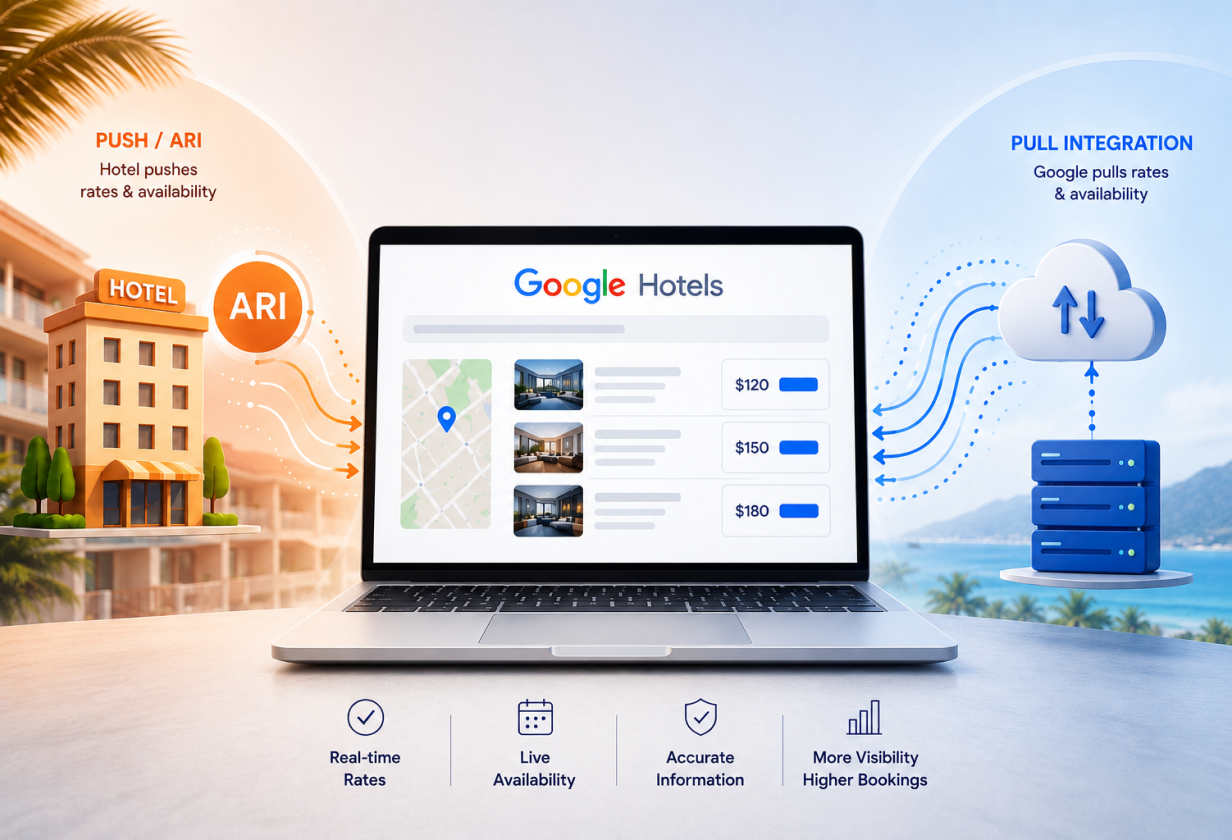
Most hoteliers never think about how their room prices end up inside Google. They just expect the right rate to show when a guest searches. But behind that one little price tag is a quiet decision your tech stack makes every day, and it has a real impact on your bookings: do your rates get pushed to Google, or does Google pull them from you?
If that sounds like jargon, stick with me. By the end of this you'll understand ARI vs pull integration well enough to ask your vendor the right questions, and to know why it matters for your direct bookings.
First, what is ARI?
ARI stands for Availability, Rates and Inventory. It's the three things any booking system needs to know about your hotel at any given moment: which rooms are open, what they cost, and how many you have left to sell.
So when people talk about what ARI is in hotels, they really mean the live data that has to stay accurate everywhere your rooms are sold, your website, the OTAs, and metasearch channels like Google. Get it wrong and you either sell a room you don't have (hello, overbooking) or show a stale price that loses you the booking.
The big question is how that ARI data travels between your system and Google. That's where push and pull come in.
Push (ARI XML push): you send the data
With a push setup, your booking engine or channel manager sends your ARI to Google the moment anything changes. Someone books a room, your price drops for the weekend, a cancellation frees up inventory, and an XML feed fires off an update almost instantly. This is what people mean by an ARI OTA XML push: your system pushes availability, rates, and inventory out as structured XML data.
The upside is freshness. Google more or less always has your current numbers, so the rate a traveler sees is the rate they actually get. Fewer surprises at checkout, fewer abandoned bookings.
Pull (cache): Google asks when it needs to
The pull model works the other way around. Instead of you constantly sending updates, Google asks your system for a rate only when it needs one, usually when a traveler searches for your property on those exact dates. Google caches whatever it gets back and reuses it for a while.
Pull can be lighter to run, but it has a catch most hoteliers don't see coming: the cache miss. If a traveler searches a date Google hasn't cached recently, there can be a delay, or worse, no rate shown at all. And a hotel with no price in the results is a hotel that doesn't get the click.
ARI vs pull integration: which is better?
For most independent hotels chasing direct bookings, push connectivity wins. Here's the short version of why.
A push connection keeps your real-time availability and pricing in front of travelers without gaps. That matters enormously for metasearch and Google Hotel Ads, where you're competing head-to-head with OTAs on the same screen. If your direct rate is missing or stale because of a cache miss, the OTA gets the booking by default, and you pay the commission you were trying to avoid.
Push also protects rate parity. When your own channels update instantly, you're far less likely to show a different price than the one Google has on file, which keeps you consistent across every channel.
Pull isn't useless. It's lighter on infrastructure and fine for lower-volume or less time-sensitive setups. But if direct bookings are the goal, freshness beats convenience almost every time.
What this means for you in practice
You don't need to become an engineer here. What you do need is to know which model your setup uses and whether your rates are reaching Google reliably. A few questions worth asking your connectivity partner or platform:
Are my rates and availability pushed to Google in real time, or pulled on demand? How quickly does a price change or a new booking reflect in Google Hotel Center? And have we ever lost visibility because of a cache miss on dates we weren't actively updating?
If the answers are vague, that's usually a sign your connectivity could be costing you bookings you'll never even see in a report.
How Hotellifyr handles connectivity
Hotellifyr is built around real-time push connectivity. Its booking engine sends your availability, rates and inventory straight to Google Hotel Center the moment they change, so your direct rate shows up fresh and accurate when travelers are comparing prices, no cache misses, no stale pricing, no missed clicks. It's the ARI OTA XML push plumbing working quietly in the background, so you can focus on filling rooms instead of debugging feeds.
Frequently Asked Questions
What does ARI stand for in hotels?
ARI stands for Availability, Rates and Inventory, the live data describing which rooms are open, what they cost, and how many remain. Keeping ARI accurate across your website, OTAs, and Google is essential to avoid overbookings and stale pricing.
What is the difference between push and pull connectivity?
With push (ARI XML push), the hotel's system sends rate and availability updates to Google as soon as they change. With pull, Google requests a rate only when needed and caches it. Push keeps data fresher; pull is lighter but can suffer from cache misses.
What is an ARI XML push?
An ARI XML push is when a hotel's booking engine or channel manager sends Availability, Rates and Inventory to a partner like Google as structured XML data in real time, every time something changes, so the displayed rate stays current.
Why does push connectivity matter for direct bookings?
Push keeps your direct rate fresh and visible on Google Hotel Ads and metasearch. If a pull-based setup hits a cache miss and shows no rate, travelers default to the OTA listing, and you lose the commission-free direct booking.
What is a cache miss in hotel connectivity?
A cache miss happens when Google doesn't have a recent cached rate for the dates a traveler searched. In a pull model this can delay or hide your price, costing you visibility at the exact moment a guest is ready to book.